Assessing cognitive changes in adult patients suspected of Alzheimer's disease demands both timely action and clinical sensitivity. Traditional pathways often involve long waits, invasive procedures and uncertainty, all of which can delay care for individuals experiencing cognitive impairment. Labcorp offers advanced and comprehensive neurological testing specifically designed to inform care decisions and support confident referrals to specialists.
Our solutions translate complex neurological data into actionable insights, supporting both early detection and continuity of care.
Equipping primary care with advanced Alzheimer's evaluation tools
As the prevalence of Alzheimer’s disease rises and patient management strategies improve, primary care increasingly serves as the entry point for initial evaluation.
Labcorp has a comprehensive suite of lab services that can aid in evaluation of mild cognitive impairment (MCI). From ruling out reversible conditions that may mimic the symptoms of MCI (vitamin deficiencies, thyroid dysfunction, etc.) to high-performance Alzheimer’s biomarkers, Labcorp’s testing solutions can expedite care and patient management.
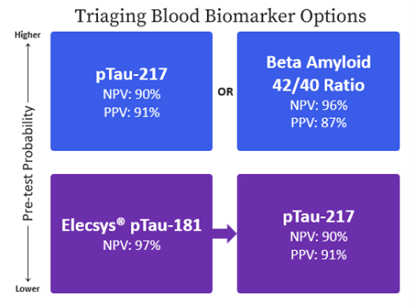
Advances in high-sensitivity immunoassays now enable blood biomarkers, such as phosphorylated tau 181 (pTau-181) and phosphorylated tau 217 (pTau-217), to serve as reliable aids in the assessment of suspected Alzheimer’s disease. Accessible blood-based tests help you better determine which individuals may benefit from referral or more in-depth neurological assessment, supporting clear clinical pathways and care continuity.
Using blood-based biomarkers in primary care: Practical guidance for early evaluation
Labcorp is proud to offer the broadest blood-based biomarker portfolio for Alzheimer’s disease and dementia. In the primary care setting, our portfolio can provide important clinical insights that expedite care and inform patient management decisions.
Correctly interpreting results of blood-based biomarkers can help you make informed decisions about the next steps in evaluating cognitive impairment. Importantly, quantitative data should always be considered alongside patient history, physical exam findings, and cognitive assessments.
Who should be tested?
Successful integration of blood biomarker tests for individuals suspected of having Alzheimer’s or other forms of cognitive impairment begins with appropriate patient selection and thoughtful consideration of pre-test probability.
Our biomarker assays are recommended for adults aged 55 and older with symptoms of MCI confirmed by cognitive assessment tools such as the Mini-Mental State Exam (MMSE) or Mini-Cog. Using objective tools to verify memory or cognitive changes increases the likelihood that test results will yield clinically meaningful information.
Rule out conditions that mimic dementia
Before ordering a test, conduct a comprehensive evaluation to exclude other treatable or reversible causes of cognitive symptoms, including:
- Thyroid disorders (e.g., hypothyroidism)
- Vitamin deficiencies (especially vitamin B12)
- Depression or other psychiatric conditions
- Medication side effects, including polypharmacy
- Structural brain abnormalities (e.g., tumors, hydrocephalus, subdural hematomas)
- Infections (such as urinary tract infections)
- Sleep disorders (such as sleep apnea)
- Traumatic brain injury
Excluding these common conditions enhances the clinical value of amyloid and tau biomarkers, allowing you to focus assessments where most needed. To support this complex decision-making, we offer educational resources and clinical tools, helping you provide targeted and person-centered care for individuals experiencing cognitive changes.

.jpg)