Complex Questions, Clear Answers.

Advancing Alzheimer's Disease Assessment in Primary Care

Advance Alzheimer's early detection with Labcorp's blood-based biomarker portfolio, which includes the FDA-cleared pTau-181 test, along with its pTau-217 and ATN Profile tests.
Female doctor talking with senior man in waiting room

Assessing cognitive changes in adult patients suspected of Alzheimer's disease demands both timely action and clinical sensitivity. Traditional pathways often involve long waits, invasive procedures and uncertainty, all of which can delay care for individuals experiencing cognitive impairment. Labcorp offers advanced and comprehensive neurological testing specifically designed to inform care decisions and support confident referrals to specialists.

Our solutions translate complex neurological data into actionable insights, supporting both early detection and continuity of care.

Equipping primary care with advanced Alzheimer's evaluation tools

As the prevalence of Alzheimer’s disease rises and patient management strategies improve, primary care increasingly serves as the entry point for initial evaluation.

Labcorp has a comprehensive suite of lab services that can aid in evaluation of mild cognitive impairment (MCI). From ruling-out reversible conditions that may mimic the symptoms of MCI (vitamin deficiencies, thyroid dysfunction, etc.) to high-performance Alzheimer’s biomarkers, Labcorp’s testing solutions can expedite care and patient management.

Advances in high-sensitivity immunoassays now enable blood biomarkers, such as phosphorylated tau 181 (pTau-181) and phosphorylated tau 217 (pTau-217), to serve as reliable aids in the assessment of suspected Alzheimer’s disease. Accessible blood-based tests help you better determine which individuals may benefit from referral or more in-depth neurological assessment, supporting clear clinical pathways and care continuity.

Using blood-based biomarkers in primary care: Practical guidance for early evaluation

Labcorp is proud to offer the broadest blood-based biomarker portfolio for Alzheimer’s disease and dementia. In the primary care setting, our portfolio can provide important clinical insights that expedite care and inform patient management decisions.  

Correctly interpreting results of blood-based biomarkers can help you make informed decisions about the next steps in evaluating cognitive impairment. Importantly, quantitative data should always be considered alongside patient history, physical exam findings, and cognitive assessments.

Who should be tested?

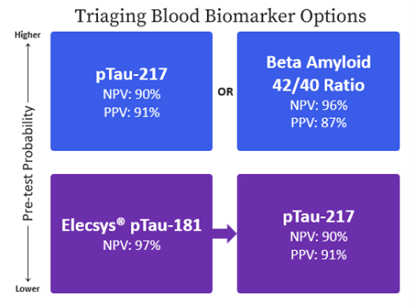
Successful integration of blood biomarker tests for individuals suspected of having Alzheimer’s or other forms of cognitive impairment begins with appropriate patient selection and thoughtful consideration of pre-test probability.

Our biomarker assays are recommended for adults aged 55 and older with symptoms of MCI confirmed by cognitive assessment tools such as the Mini-Mental State Exam (MMSE) or Mini-Cog. Using objective tools to verify memory or cognitive changes increases the likelihood that test results will yield clinically meaningful information.

Rule out conditions that mimic dementia

Before ordering a test, conduct a comprehensive evaluation to exclude other treatable or reversible causes of cognitive symptoms, including:

  • Thyroid disorders (e.g., hypothyroidism)
  • Vitamin deficiencies (especially vitamin B12)
  • Depression or other psychiatric conditions
  • Medication side effects, including polypharmacy
  • Structural brain abnormalities (e.g., tumors, hydrocephalus, subdural hematomas)
  • Infections (such as urinary tract infections)
  • Sleep disorders (such as sleep apnea)

Excluding these common conditions enhances the clinical value of amyloid and tau biomarkers, allowing you to focus assessments where most needed. To support this complex decision-making, we offer educational resources and clinical tools, helping you provide targeted and person-centered care for individuals experiencing cognitive changes.

Icon of a person on a computer with a gear behind them

Cognitive Assessment

Examples:

  • Mini-Cog
  • General Practitioner assessment of cognition (GPCOG)
  • Montreal Cognitive Assessment (MoCA)
  • Mini-Mental State Examination (MMSE)
  • Others
Icon of two people within a box frame

Exclude Other Causes of MCI

Examples:

  • Vitamin deficiencies
  • Medication side effect
  • Depression
  • Thyroid disorders
  • Traumatic brain injury
  • Infections
Icon of three people with an arrow pointing upward

Alzheimer’s Blood Biomarkers

Using cognitive assessments and ruling-out reversible conditions that may mimic the symptoms of dementia and AD prior to utilization of blood biomarkers will increase the pre-test probability of Alzheimer’s and thus increase their predictive value.

Labcorp's comprehensive portfolio of Alzheimer’s blood biomarkers for primary care

Optimize care management with the industry's leading portfolio of biomarkers for Alzheimer's disease assessment. Our solutions empower you to deliver timely evaluation, streamline referrals, and bring confidence and clarity to individuals experiencing symptoms of cognitive impairment. Biomarkers results should be interpreted within the context of all clinical findings.

Elecsys® pTau-181 Test: FDA cleared as an Alzheimer’s rule-out test in primary care

Labcorp is the first to offer the FDA-cleared Elecsys® pTau-181 plasma assay to primary care providers. It’s the first blood-based biomarker test of its kind, designed to support the initial assessment of cognitive impairment in adults aged 55 and older when Alzheimer’s disease or other causes of cognitive decline are suspected.

The Elecsys pTau-181 test helps providers rule out Alzheimer’s pathology earlier in the care management cycle. With its high negative predictive value, a negative result gives confidence to investigate other potential causes of cognitive changes, reducing unnecessary specialist referrals and supporting efficient use of healthcare resources.

Intended use: Aid in assessing the absence of key biological changes that are consistent with Alzheimer's disease pathology. Patients with negative results have a lower likelihood of Alzheimer’s disease and should be investigated for other causes of cognitive decline.1

Negative result (<0.722 pg/mL):

A result below 0.722 pg/mL is considered negative and strongly correlates with a negative amyloid PET scan (negative predictive value: 97.9%). This means Alzheimer’s-related amyloid pathology is unlikely, and in such cases, consider other common causes of cognitive symptoms should be considered.

Positive result (≥0.722 pg/mL):

A result at or above 0.722 pg/mL does not rule out amyloid pathology. Further evaluation is recommended. For these patients, consider referral to neurology or memory care for confirmatory testing (e.g., amyloid PET scan or CSF analysis) to ensure a comprehensive workup.

Please note: The Elecsys pTau-181 test is designed to support initial assessment of cognitive impairment, not to predict future dementia or monitor treatment response. When used in context, this tool helps you direct patients to the right resources at the right time.

Test Name

Test No.

Clinical Comments

Performance

Elecsys® pTau-181

452560

FDA cleared; a negative test result is consistent with a negative amyloid positron emissions tomography (PET) scan result and reduced likelihood that a patient’s cognitive impairment is due to amyloid pathology. These patients should be investigated for other causes of cognitive decline.

NPV: 97.9%

PPV: 22.4%

Evaluating Alzheimer’s disease pathology

Intended use: Aid in determining the presence of key biological changes that are consistent with Alzheimer's disease pathology. Patients with abnormal results have a higher likelihood of Alzheimer’s disease.

Test Name

Test No.

Clinical Comments

Performance

ATN Profile

484400

Profile includes – Beta Amyloid 42/40 Ratio, pTau-181 (LDT), Neurofilament Light Chain (NfL)

Beta Amyloid 42/40 Ratio:
(Sensitivity: 96%, Specificity: 87%)

Phosphorylated Tau 217 (pTau-217)

484390

To aid in the biological identification of Alzheimer’s disease by measuring pTau-217, which has been shown to be a surrogate for amyloid pathology

(Sensitivity: 95%, Specificity: 87%)

As primary care evolves, so do evaluation tools for Alzheimer’s disease. As your neurology partner, we're proud to offer the FDA-cleared Elecsys® pTau-181, ATN Profile, and pTau-217 blood tests and the leading portfolio of neurological biomarkers for Alzheimer's disease assessment.

Explore neurology testing solutions tailored to your needs

Contact a Labcorp representative to learn more about how we can help meet your neurology testing needs