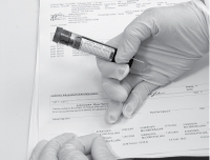
Blood Specimens: Chemistry and Hematology
(See specific Microbiology Specimen sections for additional instructions.)
Blood Components
In the average adult male there are approximately 5 quarts (4.75 liters) of blood, composed of about 3 quarts (2.85 liters) of plasma and 2 quarts (1.9 liters) of cells.
Blood cells are suspended in the plasma, which is made up of water and dissolved materials, including hormones, antibodies, and enzymes that are being carried to the tissues, and cellular waste products that are being carried to the lungs and kidneys.
The major blood cells are classified as red cells (erythrocytes), white cells (leukocytes), and platelets (thrombocytes).
The red cells are delicate, round, concave bodies that contain hemoglobin, the complex chemical that transports oxygen and carbon dioxide.
Hemolysis occurs when the thin protective membrane that encases the fragile red cells is ruptured, allowing hemoglobin to escape into the plasma. Hemolysis can be caused by rough handling of a blood specimen, leaving the tourniquet on too long (causing blood stasis) or squeezing the tip of the finger too hard during capillary collection, dilution, exposure to contaminants, extremes in temperature, or pathologic conditions.
The primary purpose of the white cells is to fight infection. In a healthy person, the white cells respond to minor infections by increasing in number and eliminating pathogens. Platelets are small fragments of special cells that aid in blood clotting.
Either plasma or serum may be separated from the blood cells by centrifugation. The essential difference between plasma and serum is that plasma retains fibrinogen (the clotting component), which is removed from serum.
Serum is obtained from clotted blood that has not been mixed with an anticoagulant (a chemical that prevents the clotting of blood). This clotted blood is then centrifuged, yielding serum, which contains two types of protein: albumin and globulin. Serum is usually collected in mottled red/gray, gold, or cherry red-top tubes, and red-top tubes are occasionally used.
Plasma is obtained from blood that has been mixed with an anticoagulant in the collection tube and has, therefore, not clotted. This mixed blood may then be centrifuged, yielding plasma, which contains albumin, globulin, and fibrinogen.
There are numerous coagulation factors (factor VIII, factor IX, etc) involved in the clotting of blood. Several different types of anticoagulants interfere with the activity of these factors to prevent clotting. Both anticoagulants and preservatives may be required for plasma specimens. The specified anticoagulant or preservative must be used for the test ordered. The chemical has been chosen to preserve some feature of the specimen and to work with the method used to perform the test. Blood collected with one anticoagulant suitable for the test described may not be considered suitable for other tests. Because additives are not interchangeable, it is necessary to consult the specimen requirement field of individual test descriptions to determine the appropriate collection requirements for the test ordered.
Blood Collection / Transport Containers
Frozen Serum. When frozen serum is required, place the plastic transport tube(s) (prepared above) immediately in the freezer compartment of the refrigerator. At the time of specimen pickup, inform your professional service representative that you have a frozen specimen to be picked up. A separate frozen sample must be submitted for each test requiring a frozen specimen. A frozen specimen should be held in a freezer at 0°C to -20°C unless a specific test requires the specimen to be frozen at -70°C (dry ice).
- If you have after-hours pickup for frozen specimens, label the tube with a permanent marker. (Water-soluble markers may wash off with freezing and transport.) Place the tube(s) in a designated freezer. Take the Labcorp TrueTherm® Frozen Keeper temperature pack and vacuum flask out of the freezer. As late as possible before the lockbox is to be put out, place the frozen transport tube(s) for a single patient in a biohazard specimen bag with the test request form, and insert the biohazard specimen bag into the flask. Then place the frozen pack on top of the specimen bag(s), and close the lid onto the flask. These containers can keep frozen specimens frozen, but they will not be able to freeze specimens at room temperature or refrigerated specimens. Refer to the Labcorp TrueTherm® Frozen Keeper Instructions for Use for further details.
- Put the Labcorp TrueTherm® Frozen Keeper containing the specimens in your lockbox according to the pictorial instructions provided (see link above). Your professional services representative will transfer the transport tube from the Labcorp TrueTherm® Frozen Keeper to dry ice for transport. The Labcorp TrueTherm® Frozen Keeper will be left in your lockbox for reuse. Specimens for multiple tests should be frozen into different transport tubes.
The Labcorp TrueTherm® Frozen Keeper is designed to fit in all standard Labcorp lockboxes.
Frozen Gel Packs. To ensure specimen integrity during warm weather, follow these Instructions for Use of frozen gel packs and specimen lockboxes.
Specimen Containers
Note: Please examine specimen collection and transportation supplies to be sure they do not include expired containers.
Red-top tube: Contains no anticoagulant or preservative.
Use: Serum or clotted whole blood. Serum must be separated from cells within 45 minutes to two hours depending on the test(s). Please refer to the specimen requirements for the test(s) of interest available in the Directory of Services. Send serum in a plastic transport tube.
Mottled red/gray-top, gold-top, or cherry red-top (gel-barrier) tube: Contains clot activator and gel for separating serum from cells, but not anticoagulant. Do not use gel-barrier tubes to submit specimens for therapeutic drug monitoring. Always check the test description to determine whether a gel-barrier tube is acceptable.
Use: Serum, may be used for assays requiring serum unless otherwise stated. Separate serum from cells within within 45 minutes to two hours depending on the test(s). Please refer to the specimen requirements for the test(s) of interest available in the Directory of Services. Serum may be sent in the centrifuge tube with an intact barrier (correct separation upon centrifugation) between cells and serum or in a plastic transport tube. If specimen is centrifuged before clotting is complete, a fibrin clot will form on top of the cell. This finding is frequent in hemolyzed specimens. Also, the gel barrier may not be intact and could cause improper separation of serum and cells, possibly affecting test results.
Lavender-top tube: Contains K2 EDTA.
Use: EDTA whole blood or plasma. Send plasma in a plastic transport tube labeled “Plasma, EDTA.” Send whole blood in a lavender-top tube.
Gray-top tube: Contains sodium fluoride (a preservative) and potassium oxalate (an anticoagulant).
Use: Sodium fluoride whole blood or plasma. Send plasma in a plastic transport tube labeled “Plasma, Sodium Fluoride.” Send whole blood in a gray-top tube.
Blue-top tube (also light blue-top tube): Contains sodium citrate. Be sure to use only tubes with a 3.2% sodium citrate concentration. These are easily identified by the yellow diagonal stripes on the label.
Use: Sodium citrate plasma. Send plasma in a plastic transport tube labeled “Plasma, Sodium Citrate.” Send whole blood in a blue-top tube.
Green-top tube: Contains sodium heparin or lithium heparin.
Use: Heparinized whole blood or plasma. Send plasma in a plastic transport tube labeled “Plasma, Sodium Heparin” or “Plasma, Lithium Heparin.” Send whole blood in a green-top tube.
Yellow-top tube: Contains acid citrate dextrose (ACD) solution.
Use: ACD whole blood. Send whole blood in a yellow-top tube.
Royal blue-top tube: Contains sodium EDTA for trace metal studies. Some royal blue-top tubes do not contain EDTA.
Use: EDTA whole blood or plasma. Send whole blood in a royal blue-top tube. Send plasma in a plastic transport tube labeled “Plasma, EDTA from royal blue.”
Tan-top tube: Contains sodium EDTA for blood lead analysis.
Use: EDTA whole blood. Send whole blood in a tan-top tube.
Plasma Preparation Tube (PPT™): Contains EDTA.
Use: EDTA plasma for molecular diagnostic tests (eg, polymerase chain reaction (PCR) and/or branched DNA amplification (bDNA) techniques). Upon centrifugation, a gel barrier is formed between the plasma and the cellular components of the blood. The tube can be sent directly to the lab without transferring to a secondary tube. Plastic tubes can be frozen at -80°C without risk of breakage.
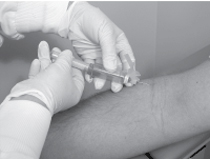
This section is presented as a guide for trained venipuncture technicians, or phlebotomists, and is not intended to train individuals in venipuncture technique. When drawing blood, please follow all venipuncture procedures recommended for use by recognized organizations and/or in accordance with applicable state regulations involving phlebotomy practices. The Clinical Laboratory Standards Institute (CLSI) is an excellent resource for additional information.
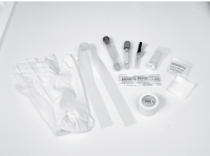
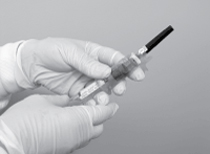
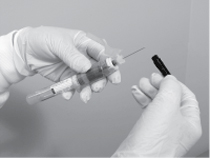
Assembling Supplies. Assemble the following supplies: lab coat, gloves, labels, safety needle, needle holder, tourniquet, appropriate tubes, gauze, alcohol sponge, adhesive strip, and sharps container. (See Figure 2.) Put on the lab coat and gloves. The aseptic method of collecting and transporting a blood specimen works on the principle of a vacuum tube for drawing blood. A double-pointed needle or multiple sample needle (both disposable) may be used for venipuncture. Ordinarily, a 21- or 22-gauge needle is used. A small bore, sharp needle causes minimum patient discomfort; 22- or 23-gauge is the smallest bore (or lumen) size recommended to avoid hemolysis. A needle length of 1 to 1½ inches permits an angle of entry that will not pierce both vein walls and enter tissue.